
B.Sc. in Soil and Water Sciences
Program Profile
The Soil and Water Sciences Department program primarily focuses on studying the interactions between soil, water, and environmental systems to address challenges in sustainable agriculture, natural resource management, and environmental conservation. It encompasses areas such as principles of soil sciences, soil physics, soil fertility, soil microbiology, plant nutrition, soil morphology and geneses, soil classification, soil and water pollution, hydrology, water quality, aquatic chemistry, soil chemistry, irrigation management, soil physio-chemical chemistry, soil ecology and meteorology, watershed managements, soil and water conservation, remote sensing, and GIS, and land use planning, aiming to develop sustainable practices that promote soil and water conservation, enhance crop production, and mitigate environmental impacts.
Occupational profiles of graduates
Qualification awarded
B.Sc. in Science in Soil and Water Sciences
Length of programme
4 years (8 semesters)
Number of credits
240 ECTS credits
Mode of Study
Full time on campus
Read more about the programme
Get detailed information about the programme requirements, courses, credits, and educational objectives as a PDF file.
Program Educational Objectives (PEOs)
Graduates of the Soil and Water Sciences programme will, within a few years of graduation, be able to:
- Advance Professional Careers: Apply foundational and advanced knowledge of soil and water sciences in careers related to agriculture, environmental management, natural resources, or related industries in public and private sectors.
- Promote Sustainable Land and Water Management: Contribute effectively to the planning and implementation of sustainable land use, soil conservation, irrigation, drainage, and water resource management strategies that meet societal and environmental needs.
- Engage in Lifelong Learning: Pursue further education, research, or professional development through graduate studies, certifications, training, or active involvement in scientific and professional organizations.
- Demonstrate Leadership and Teamwork: Exhibit strong leadership, communication, and teamwork skills in interdisciplinary and multicultural environments to solve complex problems related to soil and water systems.
- Apply Ethical and Responsible Practices: Uphold ethical principles, environmental stewardship, and national/international regulations in professional practice and decision-making related to soil and water resource use.
Program Learning Outcomes
Upon successful completion of the Soil and Water Sciences program, graduates will be able to:
1-Apply Foundational Knowledge: Demonstrate comprehensive understanding of soil science principles, including soil physics, chemistry, fertility, and microbiology, to assess soil health and productivity.
2-Analyze Soil-Water Interactions: Evaluate the interactions between soil and water systems, focusing on hydrology, water quality, and aquatic chemistry to develop sustainable water management strategies.
3-Implement Sustainable Agricultural Practices: Develop and apply sustainable land use and agricultural management plans to optimize plant nutrition and soil fertility while minimizing environmental degradation.
4-Assess Soil and Water Pollution: Identify sources and impacts of soil and water pollution, and recommend appropriate remediation and pollution prevention techniques.
5-Conduct Soil Classification and Mapping: Utilize soil morphology, genesis, and classification methods to accurately characterize and map soil types for effective land use planning.
6-Design and Manage Irrigation Systems: Develop efficient irrigation systems based on soil physio-chemical properties and water availability to support sustainable agricultural practices.
7-Apply Meteorological and Watershed Management Principles: Integrate meteorological data and watershed management techniques to predict and mitigate the effects of climatic variability on soil and water resources.
8-Conduct Research and Data Analysis: Apply quantitative and qualitative research methods to investigate soil and water-related challenges, analyze data, and present findings effectively.
9-Promote Environmental Stewardship: Advocate for soil and water conservation practices that support ecosystem health, biodiversity, and sustainable development.
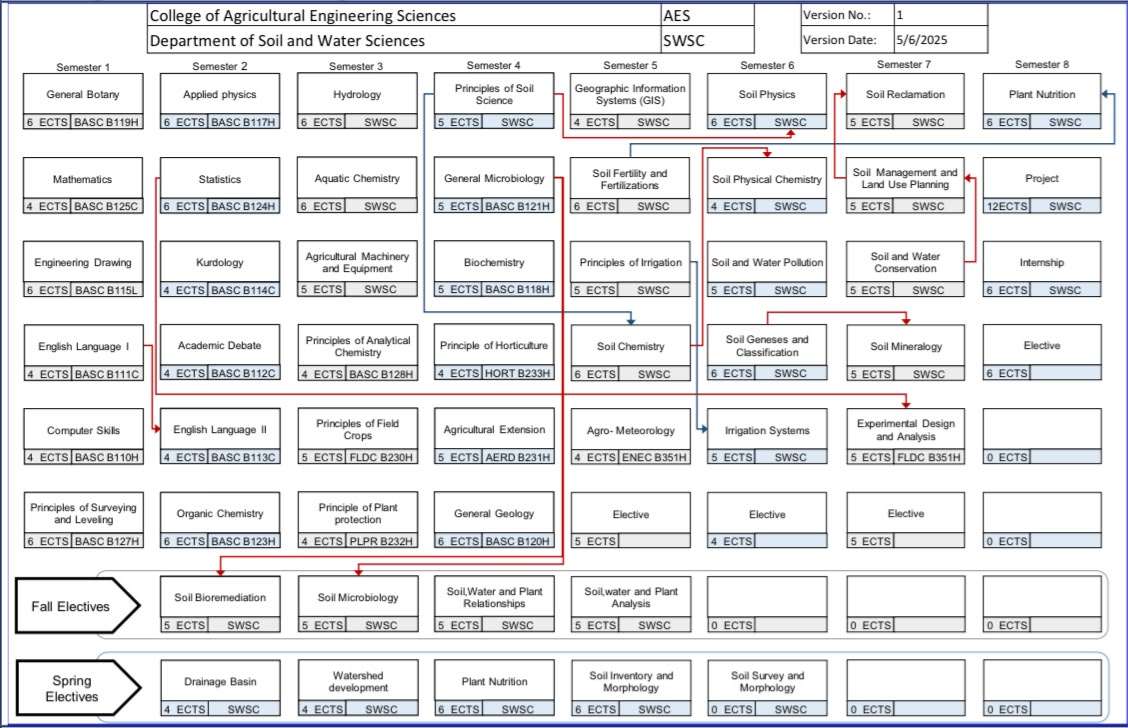
Programme structure diagram with credits
Yearly Timeline
Sept. 1, 2026
⚠️ First year students start around mid-October
⚠️ First year students start exams around 20 of January
July 1, 2027
Check out the full academic calendar on UoD's webstie.
Programme Coordinator

Assistant Professor in Irrigation
Soil and Water Sciences
College of Agricultural Engineering Sciences
University of Duhok
Apply to the Programme
Public undergraduate admissions in the KRG region are managed centrally by the Ministry of Higher Education through the online ZankoLine portal (regayzanko.com). After Grade 12 Baccalaureate results are released, high schools provide students with unique login credentials to rank their preferred universities and B.Sc. majors during a 10–14 day registration window. Final placement is automatically determined by the student's Grade 12 average, subject choices, and department capacity.