
B.Sc. in plan protection
Program Profile
The main focus of the plant protection department program is to equip students with comprehensive knowledge and practical skills in plant protection, highlighting the efficient management of plants. In order to facilitate achieving the mission of the department, Plant Protection program covers several areas of interest as Plant Diseases, Economic insects, Insect Taxonomy, Insect Physiology, Insect Morphology, Integrated Pest Management (IPM), Medical and Veterinary Entomology, Mycology, Nematology, Virology, Non - insect animal pests and Pesticides and control equipment. The Plant protection department implements its goals and objectives through well balanced integration between education, research, and outreach activities.
Occupational profiles of graduates
Give a brief description of the types of jobs for which the program prepares students and/or that graduates generally fulfil. The Plant Protection Department offers diverse areas of studies to prepare them for careers in public and private sectors. Careers include:
1-Ministry of Agriculture / Plant Protection sector.
2-Agricultural quarantines.
3-Seeds store stations (Silo).
4-High school education.
5-Academic and Research Institutions
6- International NGOs (e.g., FAO, WFP, etc.)
7-Private sector (Agricultural companies).
Qualification awarded
B.Sc. in Agricultural Science in Plant protection
Length of programme
4 years (8 semesters)
Number of credits
240 ECTS credits
Mode of Study
Full time on campus
Read more about the programme
Get detailed information about the programme requirements, courses, credits, and educational objectives as a PDF file.
Program Educational Objectives (PEOs)
The objectives of the Bachelor's Degree program in Plant Protection are:
- To provide students with strong theoretical knowledge and practical training in agriculturally important plant diseases and pests, including the biology and ecology of pathogens and pests, the use and environmental impact of pesticides, and the principles of integrated pest management (IPM).
- To meet the demand for qualified professionals in both the private and public agricultural sectors by equipping students with up-to-date technical knowledge and skills in crop protection.
- To promote and conduct both basic and applied scientific research in plant protection, enabling graduates to address and solve critical agricultural problems.
Program Learning Outcomes
After successfully completing this program, students should be able to:
- Apply knowledge and principles of basic sciences to problems in plant protection.
- Understand the systematics, morphology, biology, ecology, and epidemiology of diseases, insects, and weeds that cause crop losses at various stages of production.
- Become familiar with control methods and their application in managing plant diseases, pests, and weeds in cultivated agricultural crops.
- Gain experience with urban entomological problems that affect human health in cities.
- Diagnose and identify diseases, insects, mites, or nematode pests that cause economic losses in stored crops and products.
- Participate in professional fairs, meetings, and events to enhance their knowledge of plant protection science and technological advances.
- Acquire the qualifications and background necessary to implement crop protection programs that meet the needs of both private and public agricultural sectors.
- Improve honey production and enhance pollination services for agriculture.
- Support and develop mushroom cultivation as a sustainable agricultural practice.
- Contribute to sustainable rural development through environmentally friendly plant protection strategies.
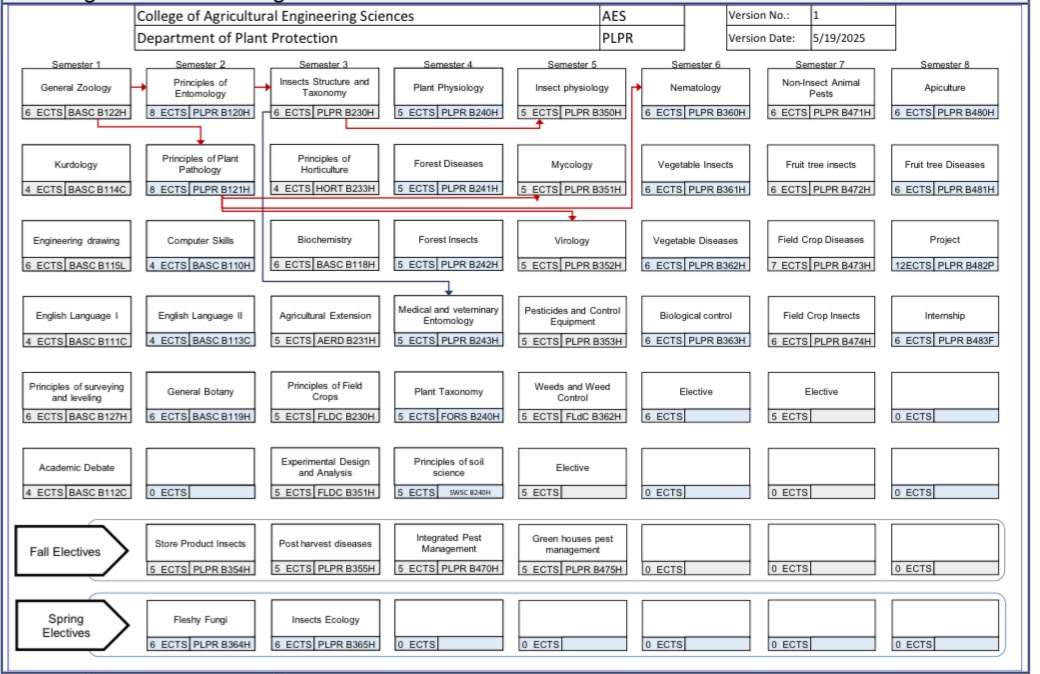
Programme structure diagram with credits
Yearly Timeline
Sept. 1, 2026
⚠️ First year students start around mid-October
⚠️ First year students start exams around 20 of January
July 1, 2027
Check out the full academic calendar on UoD's webstie.
Programme Coordinator

Professor in Biological Control
Plant Protection
College of Agricultural Engineering Sciences
University of Duhok
Apply to the Programme
Public undergraduate admissions in the KRG region are managed centrally by the Ministry of Higher Education through the online ZankoLine portal (regayzanko.com). After Grade 12 Baccalaureate results are released, high schools provide students with unique login credentials to rank their preferred universities and B.Sc. majors during a 10–14 day registration window. Final placement is automatically determined by the student's Grade 12 average, subject choices, and department capacity.